
Why Dentists Still Text PHI—and Why It’s a Problem
Texting patient information is common in dentistry, but is it HIPAA-compliant? Learn the risks of sharing PHI via text and how secure dentist-to-dentist communication can improve care.

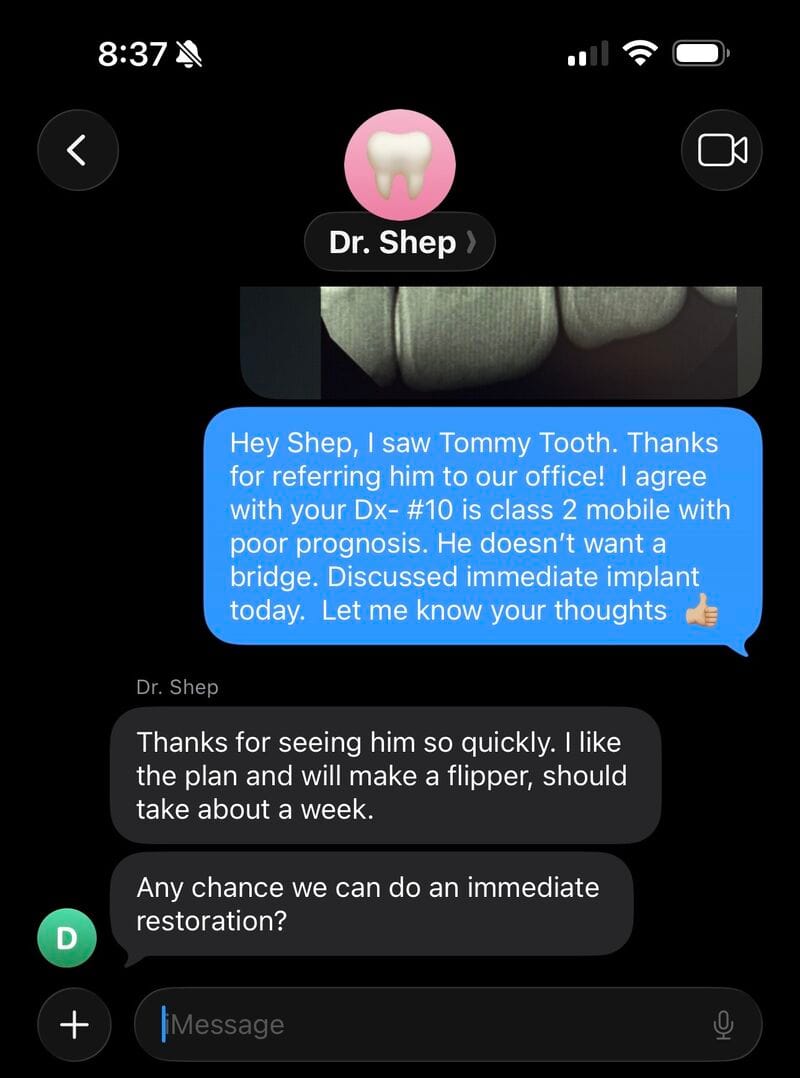
Clinical communication in dentistry is often improvised.
It’s often a quick text or email exchange between a referring general dentist and a receiving specialist. A photo of an x-ray. A short note about symptoms or urgency. It’s fast, convenient, and—when everyone is juggling packed schedules—often the easiest way to move a patient’s care forward.
But that convenience comes at a cost.
Texts and emails are difficult to document properly. They live on personal phones, disconnected from the patient record. Files get buried in message threads. Knowledge is lost in translation. Context disappears.
It's convenient in the short term, but begs an important question:
Is this kind of communication actually HIPAA-compliant?
How HIPAA Applies to Dentist-to-Dentist Texting
The issue isn’t that dentists are careless. It’s that the tools haven’t kept up.
HIPAA governs how protected health information (PHI) is handled, stored, and transmitted. In dentistry, PHI includes patient names, treatment details, x-rays, clinical photos, and any information that can be linked back to an identifiable patient.
When this information is shared electronically—through texts, emails, or photos—it becomes electronic protected health information (ePHI), which is subject to HIPAA’s Security Rule.
Standard texting and email tools weren’t built with these requirements in mind. Messages aren’t consistently encrypted. Access controls are weak or nonexistent. There’s no audit trail showing who viewed what, when, or where the information lives afterward.
The Department of Health and Human Services has made this clear:
Texting patient information can be permissible—but only when it’s done through a secure, HIPAA-compliant platform. Standard SMS, iMessage and WhatsApp messages do not meet this standard.
Why Dentists Still Text Patient Information Anyway
Dentistry doesn’t have a modern, secure, frictionless way to collaborate on cases across practices.
So the industry defaults to whatever works in the moment—texts, calls, photos, screenshots—because speed matters and patients can’t wait. When the system doesn’t support the workflow, people create workarounds that feel “good enough,” even when they introduce risk and compromise patient care.
This affects everyone:
- General dentists lose visibility once a patient leaves their office
- Specialists receive incomplete or fragmented context
- Office staff chase information across phones, inboxes, and paper
- Patients experience delays, miscommunication, and disjointed care
Communication is critical—but it shouldn’t require tradeoffs between speed, clarity, and security.
The Hidden Risks of Texting PHI
Non-compliant texting introduces real risks, even when nothing “goes wrong” on the surface.
Messages can be intercepted. Phones get lost or shared. Images and files live indefinitely on personal devices. There’s no reliable way to attach these conversations to the patient record or ensure they’re accessible to the rest of the care team.
And when something does go wrong, the consequences can be serious—legal exposure, reputational damage, financial penalties, and operational disruption that pulls focus away from patient care.
More importantly, fragmented communication increases the likelihood that important clinical details get missed altogether.
Why This Is a Systems Problem—Not a Behavior Problem
Dentists aren’t choosing risky communication because they want to. They’re choosing it because it’s fast.
The real problem is that dentistry has been forced to choose between convenience and proper documentation for far too long.
Conversations about patient care shouldn’t be scattered across phones, inboxes, and referral pads—disconnected from referrals or the clinical record itself.
This is the gap Sindi was built to address.
A Better Way to Communicate Across Dental Practices
The goal isn’t to slow anyone down or force new habits for the sake of software.
It’s to offer seamless, secure messaging and referrals that feel just as easy as texting—while actually belonging in a professional, HIPAA-compliant digital system.
With Sindi, messages, files, and referrals live in one place. Conversations stay tied to the patient. Communication works on both desktop and mobile. And everyone involved in care has the same context, without chasing information or compromising security.
Because efficient interoffice communication is more critical than ever. Dentists are being asked to do more, faster, with fewer resources. Without better tools, they’ll continue patching together systems just to get through the day.
The real question is this: how long will dentistry continue to rely on stopgaps that weren’t designed specifically for patient care? Are dentists ready to embrace tools like Sindi that are built specifically for them?
We think dentistry is ready.
Are you ready for an alternative to texting PHI?
You can try Sindi for free today.